Table of contents
Hide sections Show sections
At a glance
| Problem | Agencies on HighLevel had to set up phone, SMS and compliance on their own, and all of those features shipped inside one large Vue app, so every team waited on a shared release. |
| My role | I orchestrated the split into micro-frontends that let each team release independently. |
| Result | Deployments 4x faster. The initial JavaScript bundle shrank 32%, first paint got 33% faster, and the time to fix incidents dropped 67%. |
| Stack | Vue.js, TypeScript, micro-frontends, code splitting, Jenkins CI/CD, frontend monitoring |
The problem
To send SMS or take calls from HighLevel, an agency used to sign up for a provider such as Twilio and wire it into the CRM by hand. That took real technical knowledge, and many agencies didn’t have it. HighLevel answered with LC (Lead Connector) Phone, its own telephony provider, which needed a frontend for buying numbers, configuring them and managing them per client.
Compliance made it harder. In the U.S., businesses sending SMS must register under A2P 10DLC, verify outgoing calls under SHAKEN/STIR and register caller names (CNAM). Get it wrong and numbers are blocked. Many customers found doing this on their own daunting.
All of this lived in one large frontend, so one release covered phone, SMS, voicemail and compliance together. As sub-accounts grew 5x, page loads and release speed had to hold up.
So the goal was for agencies and their clients to set up phone service without a manual process or local software, using either HighLevel’s own telephony or a provider like Twilio, with compliance registration guided rather than left to them. On the engineering side, each feature team needed to ship on its own schedule, and pages had to stay fast in every supported browser as usage grew.
Architecture
Key decisions
Drawing the boundaries by product area
| Decision | Split the app along product areas (phone setup, LC Phone, SMS and voicemail, compliance). |
| Alternatives | Splitting by technical layer, or keeping one app with lazy-loaded routes. |
| Cost | Code shared across apps, and the work of keeping the UI consistent. Each app also had to fit into the host while staying independent, which we handled with an event system and carefully designed API interfaces. |
Code-splitting the initial bundle
| Decision | Move code out of the initial bundle. |
| Result | The bundle got 32% smaller and first paint (FCP) came 33% sooner. |
Monitoring each app on its own
| Decision | Add frontend monitoring and alerting per app. |
| Why | Once every app deployed separately, a broken release had to be traced to one app quickly. |
| Result | The time to fix incidents (MTTR) fell 67%. |
Result
Deployments became 4x faster, and page loads held steady while sub-accounts grew 5x. The initial bundle is 32% smaller, first paint is 33% faster, and incidents get fixed in a third of the time.
Two things shaped the work more than I expected. Regular feedback sessions with agency owners and beta testers caught usability problems early, and working closely with legal and compliance experts kept Trust Center in line with current regulations.
Appendix: the four micro-frontends
Each product area became its own app, released on its own.
Every telephony provider’s API had its own quirks, so an integration layer absorbed them and the interface stayed the same whichever provider an agency used. Regulations also differ by country, so LC Phone got a compliance module that adapts to each region and walks users through its steps. For the heaviest registrations, Trust Center uses step-by-step wizards that explain each stage, so users get through compliance without feeling overwhelmed and understand why each step matters.
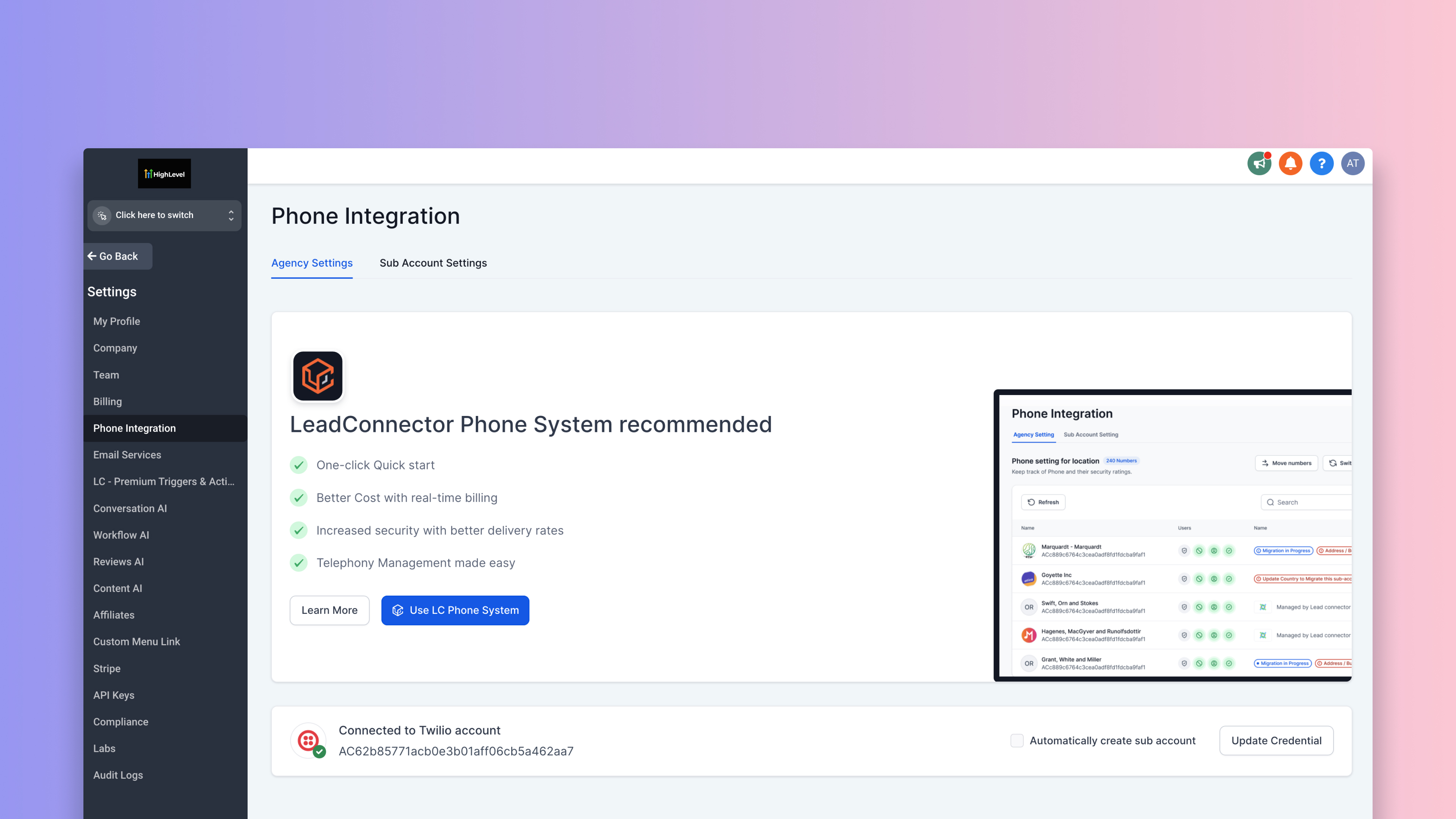
1. Phone Integration: agency setup
Where an agency connects telephony and manages it for its clients.
Integration page
With SaaS mode enabled, agencies can resell HighLevel’s telephony to their clients with no local software. One page connects either HighLevel’s native telephony or a third-party provider such as Twilio, with the whole setup in one place.


Sub-accounts
An agency creates a sub-account per client. Each one has its own configuration, data and resources, so the agency can tailor the platform per client, manage permissions and keep clients apart.


Number migration
Agencies move phone numbers between sub-accounts of a client’s external provider, from HighLevel’s agency to an external provider, or between sub-accounts inside HighLevel, with step-by-step instructions and safeguards against accidental transfers.


2. LC Phone System
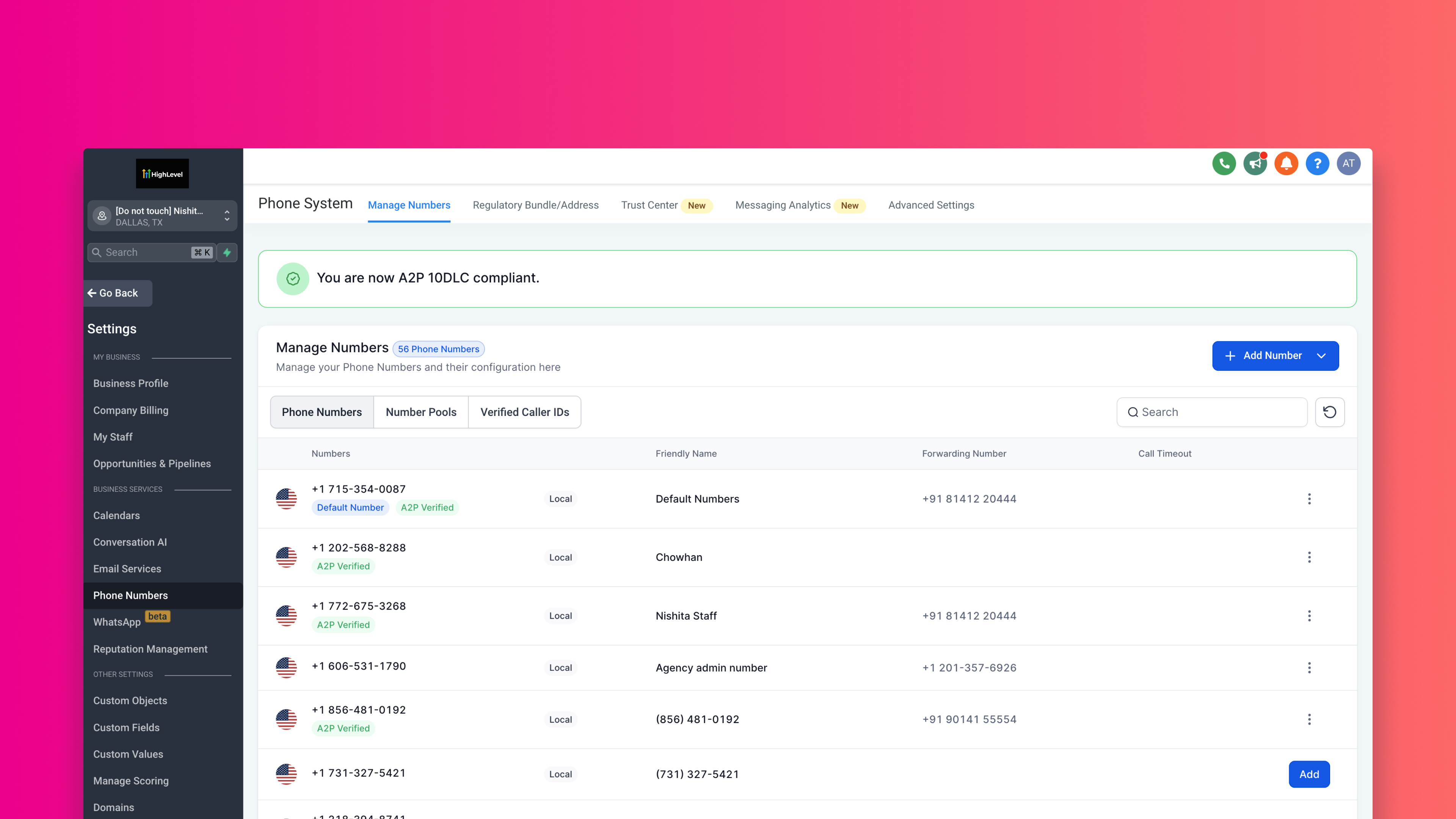
HighLevel’s built-in telephony: buy and manage numbers, verify caller IDs and track calls, without a separate provider account.
Managing phone numbers
Buy, configure and maintain local, mobile and toll-free numbers for supported countries, inside HighLevel.


Buying a number, with Stripe
Browse available numbers, pick one and pay through Stripe without leaving HighLevel. In countries with regulatory requirements, the flow collects the address and compliance documents it needs.


Verified caller IDs
Clients can show their own phone number as the caller ID, so recipients see a familiar number and answer more often.


Number pools
Number pools assign specific numbers to leads on chosen landing pages or websites, so each call can be traced to the paid campaign that produced it. Other tools call these “call tracking codes”.


3. SMS & Voicemail settings
One place for every SMS and voicemail setting.

SMS provider
One-click setup for LC, HighLevel’s built-in SMS provider, so users can start messaging straight away. External SMS providers are still supported.

Voicemail and missed calls
Upload a custom voicemail greeting per phone number or one for the whole business. Missed Call Text Back previews and automatically sends a text to callers who didn’t get through.


SMS compliance
Number validation checks that a mobile number is valid before sending, which cuts undelivered messages and protects sender reputation. Every message carries opt-out instructions such as “Reply STOP to unsubscribe”, and sender info identifies the business in each message.


Messaging limits
Each sub-account has a cap on SMS sent in 24 hours. If a sub-account’s opt-out rate goes above a threshold (around 2%), it’s locked from sending for 24 hours.


4. Trust Center: compliance
Guided registration for U.S. SMS and voice rules, so customers can comply without managing their own Twilio account.
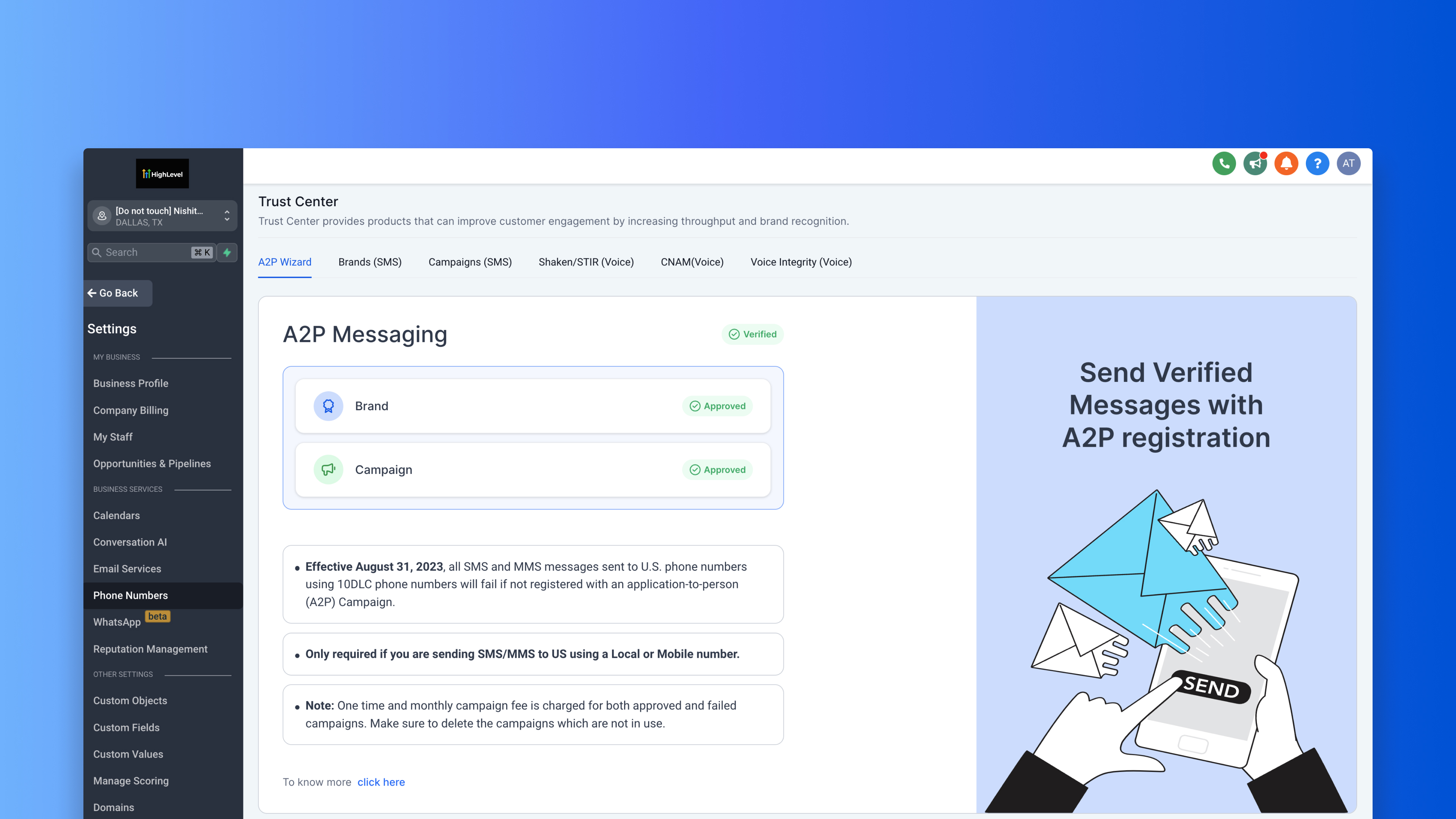
A2P 10DLC brand and campaign registration
Businesses register their brand and campaigns so they can send SMS from 10-digit long code numbers (local or national) to U.S. recipients.


SHAKEN/STIR
Verifies that the business is the one placing the call, which cuts spam flags and makes recipients more likely to answer.

CNAM
Registers the caller ID name, so the business name shows correctly on outbound calls.

A2P messaging registration
Automated business-to-person messages must be registered, or carriers block them as spam. This flow walks the business through that registration.


Technology Stack


Hiring for a senior frontend role?
I'm open to remote or hybrid (Bengaluru) senior frontend roles and available immediately.